
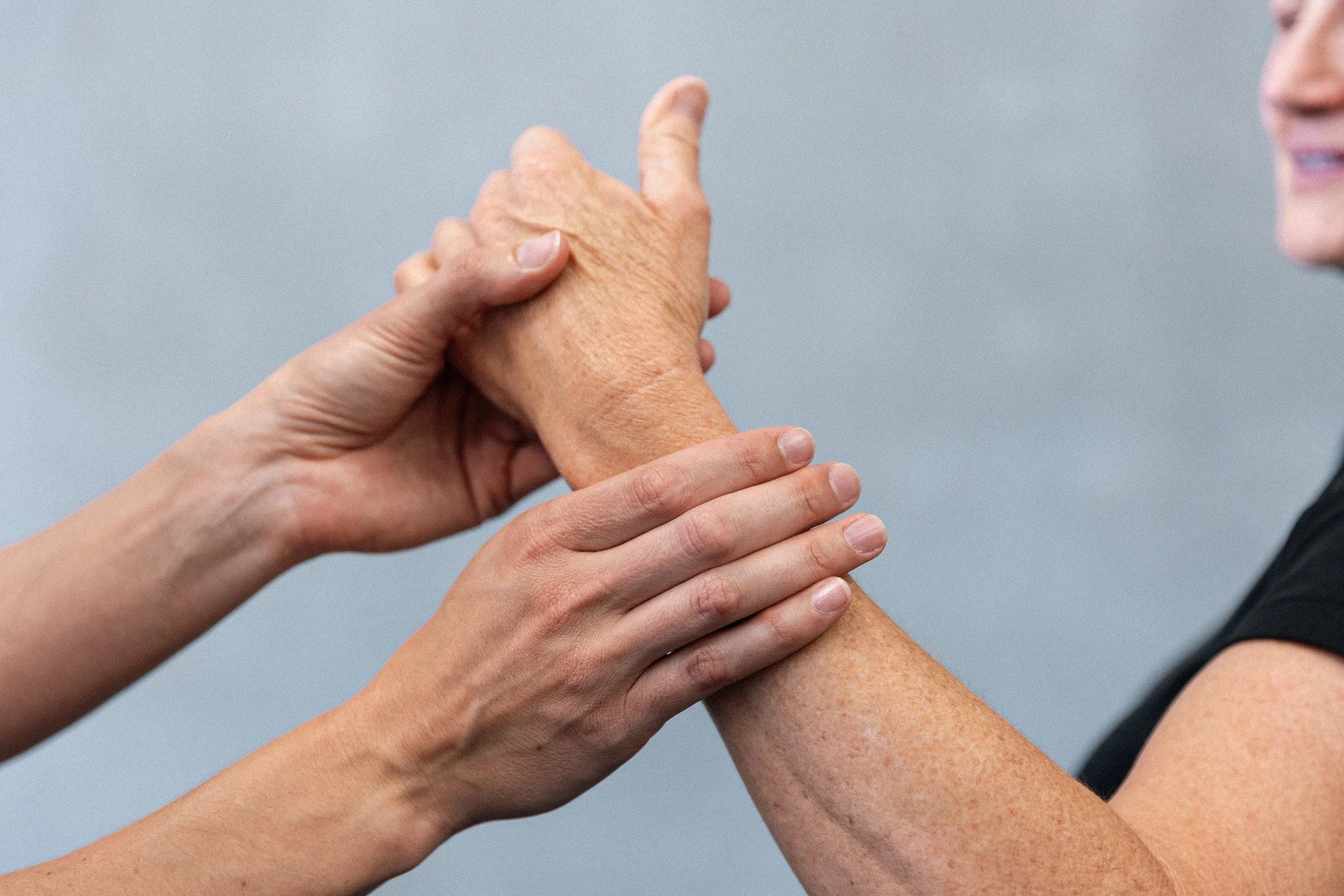
Elbow, Wrist and Hand Pain + Injuries
A few of the elbow, wrist & hand conditions we treat
Your elbows, wrists and hands are involved in almost everything we do from working and training to typing, cooking and playing sport.
Pain in these areas usually come from muscles, tendons, nerves, joints, or ligaments. Physiotherapy can help identify what is contributing to your symptoms, settle pain and irritation, restore movement and strength, and progressively get you back to the activities you enjoy.
Here are some of the common elbow, wrist and hand conditions we treat...
Elbow Injuries + Conditions
Golfer’s Elbow
Golfer’s elbow, or medial epicondylalgia, is an irritation of the tendons that attach the forearm muscles to the inside of your elbow. It may also involve irritation of the nerves in the same area.
Despite the name, you don't need to play golf to develop it. Repetitive gripping, lifting, throwing or wrist movements can all contribute.
How can physio help?
We can assess what is contributing to the tendon overload / nerve irriation, modify aggravating activities and progressively strengthen the forearm and wrist. Treatment may also include mobility work, load management and a gradual return to work, gym or sport.
How long does it take?
Milder cases may improve within 6–12 weeks, while longer-standing or more irritable cases can take several months. Tendons generally respond best to gradual, consistent loading rather than complete rest which may include a long term and ongoing management plan.
Tennis Elbow
Tennis elbow, or lateral epicondylalgia, affects the tendons attaching the forearm muscles to the outside of your elbow.
Like golfer’s elbow, it is not exclusive to its namesake sport. Repetitive gripping, lifting, racquet sports, manual work and gym training can all contribute.
How can physio help?
Physio can help identify the activities contributing to the problem and develop a progressive strengthening program for the wrist, forearm and elbow. We can also help modify technique, training loads and work tasks while the tendon settles.
How long does it take?
Similar to Golfer's Elbow milder cases may improve within 3 months, while longer-standing or more irritable cases can take 6-9 months. Tendons generally respond best to gradual, consistent loading rather than complete rest which may include a long term and ongoing management plan.
Olecranon (Elbow) Bursitis
The olecranon bursa is a small fluid-filled sac over the point of your elbow. When it becomes irritated, it can cause noticeable swelling, tenderness and pain.
It can develop following a knock to the elbow or from repeated pressure, such as leaning on your elbows or spending lots of time on your hands and knees.
How can physio help?
We can help identify what is irritating the bursa, modify loading and pressure through the elbow, maintain movement, gradually restore strength and function, and determine if other health care professionals need to become involved.
How long does it take?
Uncomplicated cases often settle within 3–6 weeks with activity modification, although recurrent or infected bursitis may take considerably longer and require additional medical treatment.
Cubital Tunnel Syndrome
Cubital tunnel syndrome occurs when the ulnar nerve is irritated or compressed around the inside of the elbow.
It can cause pain around the elbow as well as tingling, numbness or weakness into the ring and little fingers.
How can physio help?
Treatment may include modifying positions and activities that compress the nerve, improving elbow and wrist mechanics, nerve mobility exercises, strengthening and sometimes splinting.
If there is significant or progressive weakness, muscle wasting or persistent symptoms, further medical assessment may be required.
How long does it take?
Milder cases can improve over weeks to months with appropriate management. Nerves can recover more slowly than muscles and tendons, so more significant nerve irritation can take several months to settle.
Elbow Arthritis
Elbow arthritis occurs when the joint becomes affected by degenerative or inflammatory changes. This can lead to pain, stiffness, reduced range of motion and difficulty with activities such as lifting or pushing.
How can physio help?
While physiotherapy cannot reverse arthritis, it can help you maintain movement and strength, manage pain, and improve how you use your elbow.
Your program may include mobility exercises, strengthening, activity modification and strategies to manage flare ups.
How long does it take?
Arthritis is generally a long-term condition rather than an injury that simply heals. Symptoms can often be improved over weeks to months, with ongoing exercise, load management as well as lifestyle changes to help maintain function and reduce the rate of the condition worsening over time.
Biceps Tendon Rupture
The distal bicep tendon attaches your bicep muscle to the radius near your elbow. A rupture can occur when the tendon is suddenly overloaded, often resulting in pain, bruising, and weakness with elbow bending and turning the palm upwards.
Complete ruptures can cause a noticeable change in the appearance of the biceps and significant loss of strength.
How can physio help?
This injury needs appropriate assessment to determine the extent of the tear and whether surgery is indicated.
Following surgical or conservative management, physiotherapy focuses on gradually restoring elbow and forearm movement, strength and function, before progressing back to work, gym and sport.
How long does it take?
A repaired tendon generally requires at least 3–4 months to heal, with heavy lifting and vigorous activity restricted for longer. Return to full sporting or heavy manual activity can take 4–6+ months, depending on the injury and rehabilitation.
Wrist & Hand Injuries
Carpal Tunnel Syndrome
Carpal tunnel syndrome occurs when the median nerve is compressed as it passes through the wrist.
Common symptoms include numbness, tingling or pain in the thumb, index, middle and part of the ring finger. Symptoms are often worse at night and may eventually affect grip and hand function.
How can physio help?
Physio can help identify aggravating activities and positions, provide advice around work and daily tasks, and use exercises, nerve mobility and appropriate splinting to reduce irritation.
More severe or persistent cases may require medical assessment and, in some cases, surgical release.
How long does it take?
Milder cases may improve over several weeks with conservative management. Following surgery, recovery is commonly around 1–3 months, although nerve symptoms can take longer to fully settle, particularly when the nerve has been compressed for a long time.
Guyon’s Canal Syndrome
Guyon’s canal syndrome occurs when the ulnar nerve is compressed at the wrist, rather than at the elbow.
It can cause tingling or numbness in the little and ring fingers, as well as weakness with gripping or fine hand movements.
How can physio help?
We can identify positions and activities that are compressing the nerve, modify loading, use splinting where appropriate and prescribe exercises to maintain movement and nerve mobility.
Persistent symptoms, significant weakness or muscle wasting may require further medical investigation.
How long does it take?
Recovery varies considerably depending on the severity and cause. Mild nerve irritation may improve over weeks to a few months, while more significant nerve compression can take several months to recover.
Radial Tunnel Syndrome
Radial tunnel syndrome occurs when the radial nerve becomes irritated or compressed as it travels through the forearm near the elbow.
It commonly causes an aching pain around the outside of the elbow and forearm, particularly with gripping, lifting or repeated wrist and forearm movements.
How can physio help?
Physios can assist with activity modification, nerve mobility exercises, strengthening and changes to work or training loads.
How long does it take?
Many people improve with appropriate conservative management within around 6 weeks, although persistent or more severe cases can take longer.
Ganglion Cysts
A ganglion cyst is a fluid-filled lump that commonly develops around the wrist or hand.
They are usually harmless and may not require treatment, but they can sometimes cause pain, pressure, reduced movement or irritation of nearby structures.
How can physio help?
If the cyst is symptomatic, physio can help manage pain, maintain wrist and hand movement and modify activities that aggravate the area. A wrist splint may sometimes be useful.
If the cyst is persistent, painful or significantly limiting function, your doctor may discuss other options.
How long does it take?
Some ganglion cysts disappear on their own and others can persist or recur. Following surgical removal, recovery is commonly around 3 weeks to 3 months depending on the location, procedure, and what level of function you are returning to.
De Quervain’s Tenosynovitis
De Quervain’s tenosynovitis affects the tendons on the thumb side of the wrist.
It can cause pain with gripping, lifting, opening jars, using your phone or moving your thumb and wrist.
How can physio help?
Treatment focuses on reducing irritation and gradually restoring the capacity of the affected tendons. This may include activity modification, education, splinting, mobility work and progressive strengthening of the thumb and wrist.
How long does it take?
Symptoms can improve over several weeks to a few months, depending on how irritable the condition is and how well aggravating activities can be modified. Persistent cases may require additional medical treatment.
TFCC Tears
The triangular fibrocartilage complex (TFCC) is a group of structures on the little-finger side of the wrist that helps stabilise the wrist and absorb load.
TFCC injuries can occur following a fall or twisting injury, but they can also develop gradually with repetitive loading.
Symptoms can include pain on the ulnar side of the wrist, clicking, reduced grip strength and pain with twisting or weight-bearing through the wrist.
How can physio help?
Depending on the injury, treatment may involve temporary protection or splinting, activity modification, restoring wrist and forearm movement and progressively rebuilding strength and load tolerance.
Some TFCC injuries respond well to conservative management, while unstable or persistent tears may require review by a hand or orthopaedic specialist.
How long does it take?
Recovery varies significantly depending on the type of tear and whether there is instability. Conservative management may take several weeks to a few months, while surgical repairs can require 3–6+ months of rehabilitation before full return to sport or heavy loading.
When should you see a physio?
You don't have to wait until pain becomes severe.
Consider seeing a physiotherapist if you:
• Have persistent elbow, wrist or hand pain
• Have pain that is limiting work, training or everyday activities
• Notice weakness or reduced grip strength
• Experience pins and needles or numbness
• Have sustained an injury or fall
• Are struggling to return to sport after an injury
• Aren't sure what is causing your symptoms
A physiotherapist can assess the area, determine what may be contributing to your symptoms and develop an individualised plan to help you get back to doing what you love.
Remember: healing times are general guides, not deadlines. Your recovery will depend on the specific tissue involved, severity of the injury, duration of symptoms, treatment approach and your individual goals.